
You Are the Field


In 1922, Bronisław Malinowski sailed to the Trobriand Islands and stayed. He pitched his tent in the village. He learned the language, attended the ceremonies, followed the canoes out to sea. He understood, in a way his predecessors had not, that you cannot study a culture from the shore. You have to go in.
Most of us, when it comes to our own lives, have been studying from the shore.
We observe our behaviour without context and draw conclusions without data. We mistake our adaptations for our character and our conditioning for our truth. We are, in the language of anthropology, insufficiently curious about our most intimate field site: ourselves.
“Anthropology doesn’t tell you what you want to know. It unsettles the foundations of what you knew already.”

Personal anthropology: the study of an interior culture
What distinguishes personal anthropology from therapy, from coaching, from any of the frameworks that have come before it, is its unit of study. We are not examining your psychology in isolation or assessing your performance against a goal. We are studying your internal culture — the beliefs, rituals, myths, and relational structures that have developed over the course of your life and that now, largely invisibly, govern how you move through the world.
We apply the anthropologist's questions to a life:
WHAT IS THE FIELD? Your history, your relationships, your body of work, the arc of your decisions over time.
WHAT ARE THE RITUALS? The habits, responses, and relational patterns you repeat — often without noticing.
WHAT IS THE KINSHIP MAP? Who has shaped you, and how do those dynamics still live in your present relationships?
WHAT IS NEVER SPOKEN? The inherited beliefs, the unexamined assumptions, the things you’ve taken for granted as simply “how things are.”
Every person is, in this sense, a culture unto themselves.

You have your own cosmology — a set of beliefs about how the world works and what your place in it is. You have your own ceremonies: the ways you mark transition, seek comfort, signal belonging. You have inherited stories — about worthiness, about safety, about what is possible for someone like you — that function exactly as cultural myths do, shaping behaviour without ever being examined directly.
The Soulprint as guided fieldwork
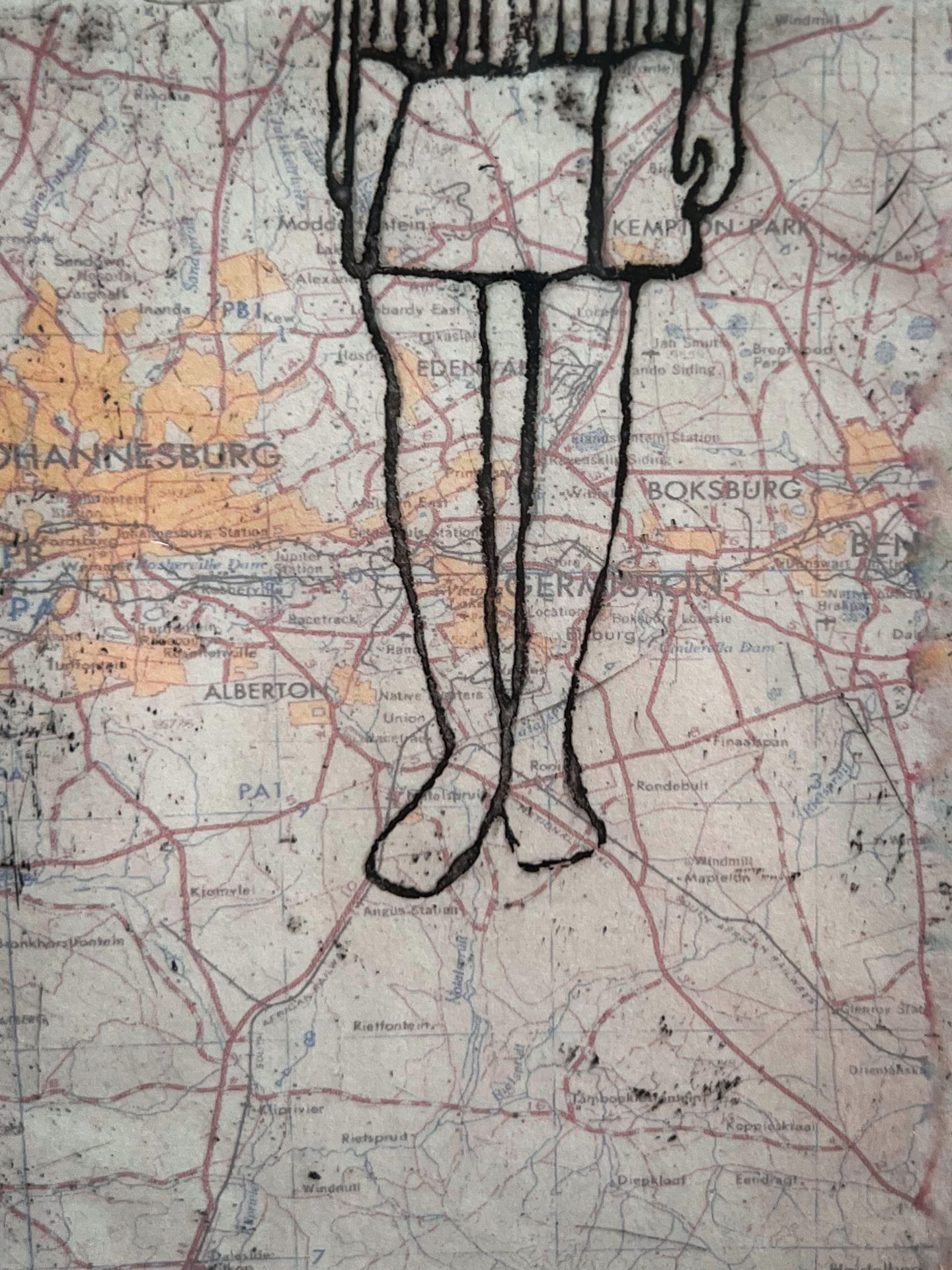
This is the work at the heart of the Soulprint. Not reinvention which implies there was something wrong with the original. Or self-improvement which implies a deficit. The Soulprint is an excavation: a careful, patient, structurally-informed process of discovering what has always been true about you, beneath the noise of expectation, comparison, and accumulated conditioning.
Field note · from practice
The word "soulprint" suggests something like a fingerprint — unique, legible, present from the beginning. It cannot be copied. It cannot be improved upon. It can only be read. The work is in learning to read it — in yourself, and eventually in others who share your life and your work.
What the Soulprint Maps
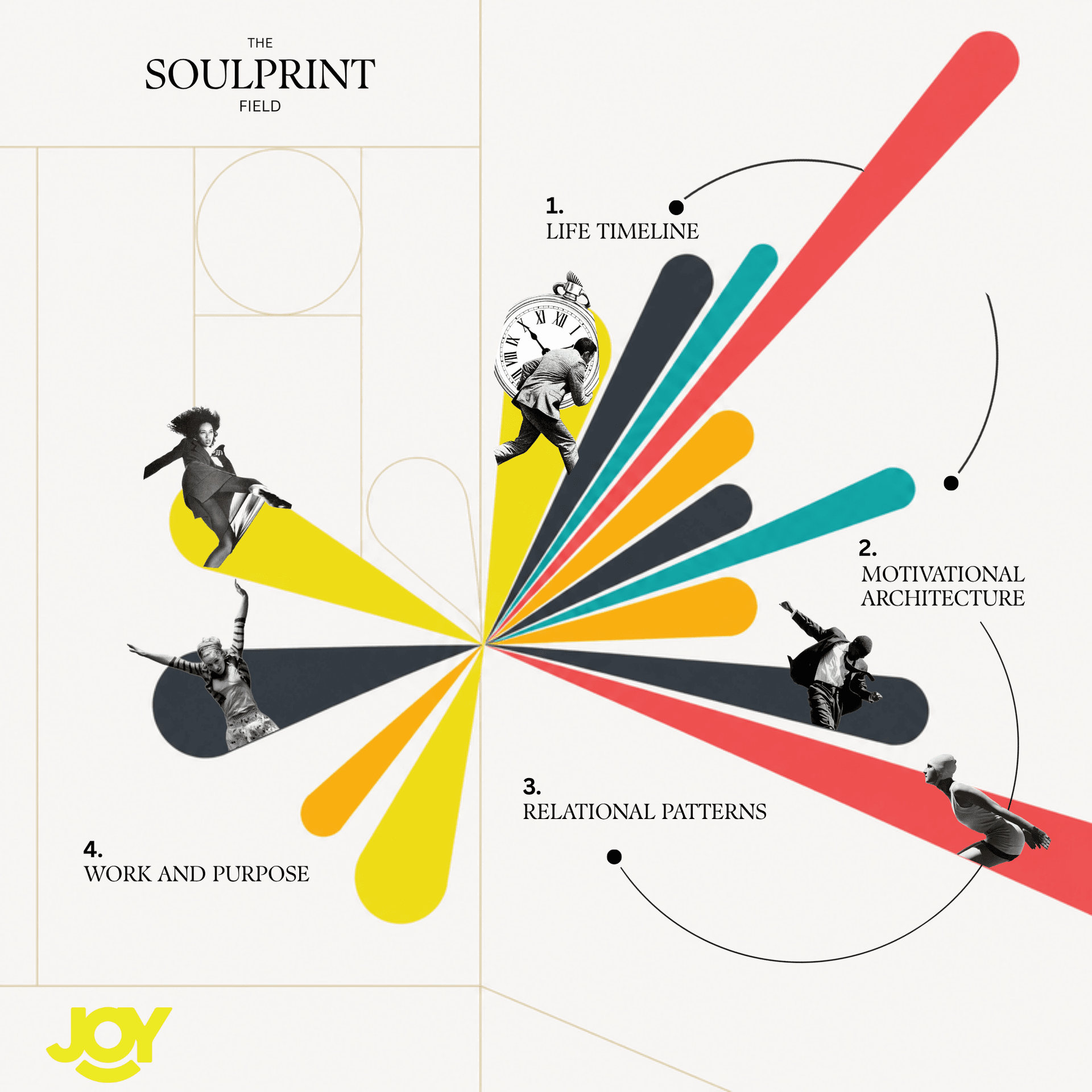
LIFE TIMELINE
The significant chapters and turning points — and what they reveal about your adaptive intelligence.
ENNEAGRAM STRUCTURE
Your motivational architecture — a lens for understanding how you orient, respond, and grow.
RELATIONAL PATTERNS
Who you seek, how you connect, where you expand and contract — and what those movements reveal.
WORK AND PURPOSE
The through-line in your vocational choices — what you’ve moved toward, what you’ve refused, and why.
What the field reveals
When people engage seriously with this kind of exploration, what tends to emerge is not what they expected. They expected to find their weaknesses and instead they find their structure. They expected to excavate wounds but find the intelligence that developed in response to those wounds. They expected conclusions and instead find questions they had never thought to ask.
There is a particular kind of relief that comes with this. When you understand why you do what you do — not in a blaming way, not in a victimhood framework, but with the same calm curiosity you'd bring to studying any complex and fascinating system — you stop being at the mercy of your patterns. The pattern becomes data. And data, unlike fate, can be worked with.
When you know how you move through the world, you can choose how you move through the world.
The humility of the method
There is one quality that every good anthropologist shares, and it is the quality most needed for this work: humility. The humility to be surprised by what you find. The humility to hold your conclusions lightly. The humility to remain a student of something — your own life — that you will never fully exhaust.
This is not comfortable. It requires a willingness to sit with complexity and resist the satisfaction of the tidy explanation. To keep looking when the easy answer presents itself. But the reward is proportional to the discomfort. What you discover, in the field of your own life, is not a fixed truth. It is a living map — one that becomes more legible the more honestly you look.
And legibility, in the end, is freedom. When you can read your own map, you know where you are, you know how you got here, and you can choose — with more clarity than you may have thought possible — where you want to go.
The Personal Soulprint
A guided process of life timeline synthesis, Enneagram integration, and pattern recognition — designed to return you to yourself.
Explore the Soulprint →